


Special education professionals carry an enormous responsibility in the years leading up to a student's exit from high school. The decisions made during that window about which services to pursue, when to refer, how to build real work experience, how to keep the student's voice at the center directly shape what life looks like on the other side.
We recently brought together three practitioners with a combined 65-plus years of experience across vocational rehabilitation, school-based transition services, and virtual program development to answer the questions that come up most often in the field. What follows is drawn directly from their conversation.
What is the difference between pre-employment transition services (pre-ETS) and full vocational rehabilitation transition services?
Pre-ETS is available to any student aged 14–21 with an IEP or 504 plan — no full application required. It focuses on career exploration, workplace readiness, and self-advocacy. Full VR transition services involve a formal intake, eligibility determination, and a broader set of supports including job placement, job coaching, and vocational training.
Marsha Spiker, a Rehabilitation Program Specialist with the West Virginia Division of Rehabilitation Services who has spent two decades in vocational rehabilitation, broke it down plainly:
Pre-ETS requires nothing more than documentation of a disability — an IEP or 504 plan — and is designed to be low-barrier by design. "There's no full application. This is just exposure to the world of work and advocating for yourself," Spiker explained. Students can participate in a few programs and step back. There's no long-term commitment attached.
Full VR transition services are a different offering. They involve assessment of training needs, vocational-technical training, one-on-one job coaching, job placement support, community rehabilitation providers, internships, and supervised work experience. Accessing them requires a formal intake process including parental consent, current documentation (IEP, 504 plan, or medical records), and eligibility determination.
The practical upshot: If your school isn't referring eligible students for pre-ETS because the full VR application process feels daunting, you're leaving resources on the table. The threshold for pre-ETS access is much lower, and the exposure it provides can be the first step toward a student eventually pursuing full VR services.
What are the biggest barriers students with disabilities face in accessing transition services?
The most common barriers are: (1) transportation and geographic isolation, (2) lack of awareness about what VR services are and who they serve, and (3) students who fall in the 'middle' — not visibly high-need, but not independently navigating services either.
Spiker named transportation and geographic isolation as her first-mentioned barrier — a practical obstacle that doesn't have an easy policy fix, particularly in rural areas. Alongside that: "The lack of early exposure — the awareness of what vocational rehabilitation services are, and that we are an employment agency — I think those are two of the biggest barriers."
She emphasized that last point deliberately. VR is an employment agency. Not a social services catch-all. When families and educators approach it with mismatched expectations, the results downstream are friction, dropped referrals, and students who lose momentum.
Jessica Garlick, who has spent 23 years in special education and 9 as a transition support teacher at Sherwood High School in Maryland's largest school district, pointed to a different gap: the student in the middle. She works with a population that runs from college-bound students to nonverbal young adults with severe autism. "The ones going to college can definitely get employment support, and even some of our really lower-level students can get the support, but I think it's kind of those middle-of-the-road young adults that fall through the cracks sometimes."
How can special education teachers improve the referral process to vocational rehabilitation?
Have current documentation ready (IEP, 504, or medical records), secure parental consent before referral, make sure families understand VR is an employment agency, and refer early — even pre-ETS participation can begin before a student ever submits a formal VR application.
Spiker walked through what she consistently sees to derail otherwise good referrals: outdated documentation, missing parental consent, and families who don't yet understand what VR does. "Parental consent is one of the biggest barriers. You can get a referral for a 17-year-old and not have parental consent, and you cannot move forward with anything at all."
Her advice on timing: don't wait. "Even if it's a senior and we're now in March, get that senior in here." Pre-ETS in particular has no strict cutoff. VR agencies are required to spend at least 15% of their budget on pre-ETS, which means the capacity concern is lower than many educators assume.
She also flagged a reality that schools don't always account for: staff turnover at VR agencies is high. "If you are expecting to get Marsha every time you go to the high school to give a referral, you're not necessarily going to get Marsha." She recommended that schools maintain relationships with multiple contacts at their local VR office rather than routing everything through a single counselor.
Garlick evolved her own referral system over years of trial and error. She used to individually contact parents before each IEP meeting to discuss VR referrals. It created overload on both sides. Now she sends program information to every parent of a student with an IEP at the start of the school year, keeps it in a monthly newsletter, and invites families to raise their hand. "By putting that ownership on the families to reach out to me, there was a little more buy-in." For families who do engage, she facilitates the initial eligibility meeting via Zoom during the school day, with the student present and the parent logging in remotely, removing a logistical barrier that was quietly killing follow-through.
How do you build work-based learning opportunities for students with disabilities when resources are limited?
Start with in-school options: connect students to existing classes aligned with their interests, create mock work environments, or build in-school businesses. You don't need a large budget or external job sites to begin. Start small, demonstrate value, and build from there.
Work-based learning is one of the strongest predictors of positive postsecondary outcomes for students with disabilities, but many schools struggle to build meaningful opportunities, especially when transportation is limited or students can't access community job sites.
Garlick's solution was to build the experience into the school itself. She repurposed a greenhouse building at Sherwood High School into a hands-on vocational training center complete with a mock grocery store, mock drugstore, mock department store, office space, and individualized job task boxes for students who need more structured, skill-by-skill practice. "Whether students can't leave, maybe because of behaviors, or their schedule, or transportation, they can come out here and practice some of those real-life job skills in this environment."
She started not with a budget, but with job task boxes she built from ideas she found on Pinterest. She solicited donations from school staff — old food boxes, clothes, props. "The amount of donations that I got from the school staff was amazing." The space grew from there. Her near-term goal: an in-school balloon business, staffed by students in her school's social-emotional program who face the most difficulty accessing off-campus work sites.
"Start small. You're going to have big goals, and everything can't be solved overnight — but be persistent. You're advocating for these students." — Kelly Dalton, University Startups
Kelly Dalton, who spent over 20 years in special education as a teacher, department head, and transition coordinator, offered a broader frame: transition skills don't need to live in a dedicated transition class. "Those things can be taught in core classes. They should be taught in core classes." Resume writing belongs in English. Financial literacy belongs in math. Work-based learning can be woven into existing structures rather than requiring a separate program.
How do you build a transition program from scratch, especially in a virtual or under-resourced school?
Start with a needs assessment — talk to teachers about what they actually need, not what you assume they need. Study NTACT resources and connect with your state's transition specialist. Build collaborative relationships with VR, workforce boards, and community agencies. Then find tools that can centralize the work and reduce administrative burden.
Dalton lived this challenge firsthand. As a transition coordinator at a newly launched virtual school, she was building a program from nothing — no school counselor yet, teachers from elementary backgrounds, no established procedures, and students spread across an entire state rather than a single zip code.
"We literally had to start with the basics. What is transition, what's it look like, what are your responsibilities," she recalled. She leaned on NTACT self-study modules, conversations with the state department's transition specialist, and early and frequent outreach to vocational rehabilitation partners to figure out what a program for a virtual school population could even look like.
She also encountered a harder problem: her students were transient, often disengaged, and came from families who'd had mostly negative experiences with school systems. Getting parents involved meant persistent phone calls and a lot of reassurance before trust was established.
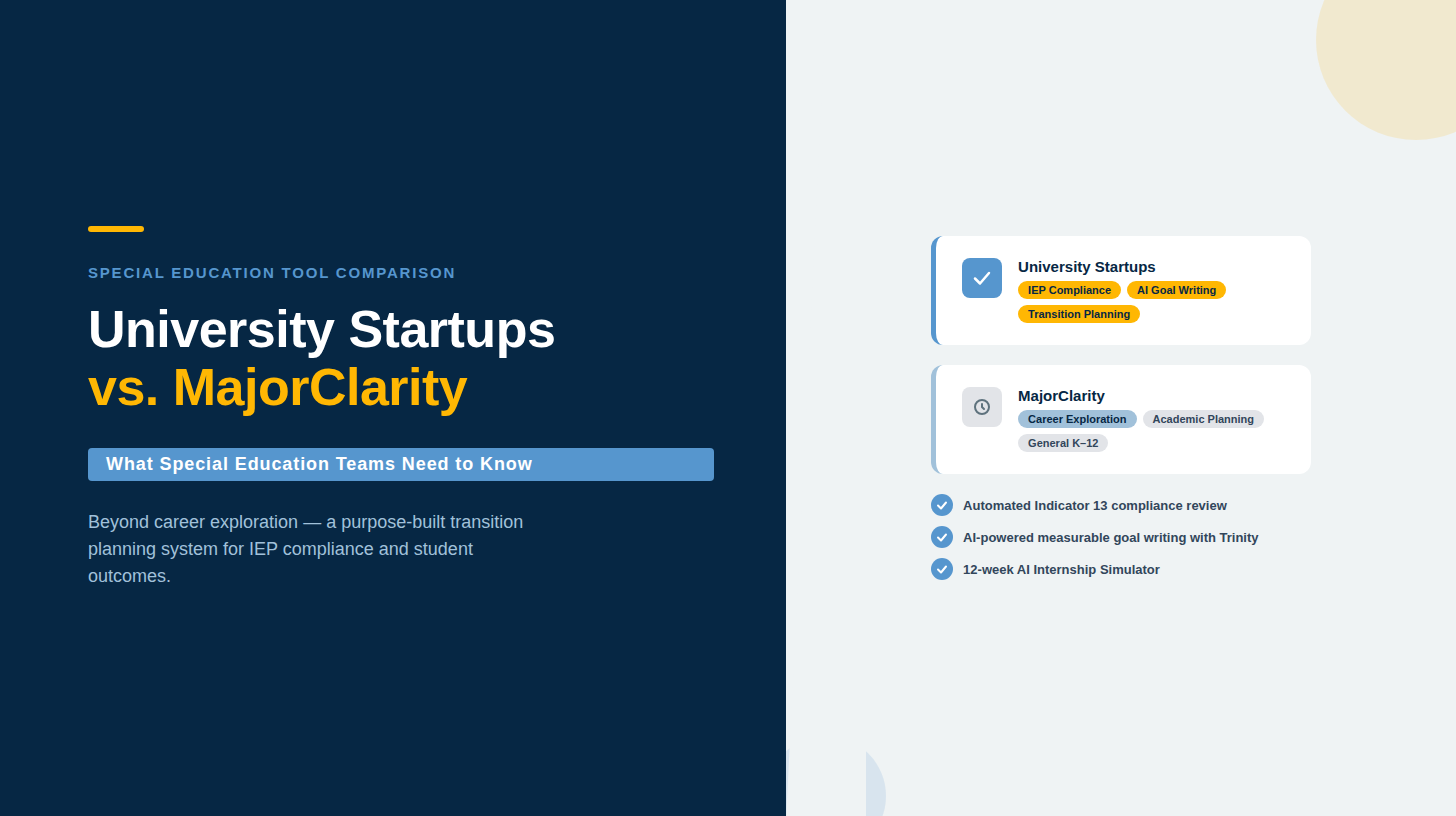
In that context, she discovered University Startups. "It checked the boxes for what we needed for a virtual setting. Everything was together. It was kind of the silent trainer for the teachers as well." The platform brought scattered transition information into a single hub — critical for a school where information had been spread across too many places and too many hands. It also introduced teachers to compliance requirements like Indicator 13 through the process of actually working through them, rather than through formal training.
But what convinced her it was working wasn't the compliance piece. It was student engagement. "They actually came. They turned on their cameras, and they were engaged. That was a huge step right there — just getting them to show up and be part of it."
"It was the central hub, which is what we needed — there was too much information in too many places." — Kelly Dalton, University Startups
What role does interagency collaboration play in effective transition services — and how do you make it work?
Effective transition services require a team around each student — not just the school, but VR, workforce boards, mental health providers, benefits counselors, and disability services agencies. Collaboration requires clear communication, aligned expectations, and a shared understanding that the student's success belongs to everyone.
"Build a team around the student, so you're not the only person," Spiker said, and she named the specific partners that often go underutilized: workforce offices, WIOA boards, mental health counselors, benefits counseling providers, and community rehabilitation organizations.
She also named an insight that took years to internalize: "It's not mine, it's ours." Early in her career, she wanted to do everything herself. She learned, sometimes the hard way, that an exaggerated strength is a weakness. Pulling other agencies in, sharing credit, letting others be co-captains on the student's team is what actually produces results.
Benefits counseling came up as an especially underused resource. Many parents are reluctant to pursue employment for their child because of fears about losing Social Security benefits. VR agencies and community providers increasingly offer initial benefits consultations that can clear up those misconceptions, and Spiker has seen that single conversation unlock a family's willingness to move forward.
The collaboration imperative extends inside schools too. Dalton pushed back on the assumption that transition is a standalone class or program. When transition skills are integrated into core academic courses — English, math, vocational electives — the work gets done at scale without requiring a separate system.
What should a special education team do first if they feel their transition services aren't strong enough?
Talk to your students first. Find out what they want and what their goals are. Then audit what already exists in your building. Use what's there before building something new. Gather your team, clarify everyone's role and expectations, and build a plan with data to support it.
The panelists were unified on the starting point: don't start with programs, start with students. "Start off by talking to the kids," Garlick said. "Get feedback from the kids — see what interests they have, what their ultimate goals are, and use that to drive your next steps."
From there, she recommended looking inside the building before looking outside it. A student interested in childcare can be connected with the child development teacher. A student who wants to work in culinary can be enrolled in the cooking class. "Try to utilize just some of those in-school natural supports or classes that are available, so you're not even having to reinvent the wheel at first."
Dalton's advice was about team process: "Really sit down and do that root cause analysis. Figure out what it is that you need to be successful, and make a plan. And stick to it." She cautioned against assuming you know what your colleagues need — ask them. Listen to what different people in the department are experiencing before deciding what the solution is.
Spiker added: make sure everyone's at the table, and name expectations explicitly. "Everybody might be working on different agendas, still helping the student, but communication is huge." That means not just what the school expects, but what parents expect, what the student expects, and what VR is positioned to deliver.
The through-line across all three answers: this work is harder to do alone than it looks, and collaboration — across agencies, across departments, across years — is what makes it sustainable.
Is Your Transition Program Ready for What's Next?
University Startups helps special education teams organize transition plans, meet Indicator 13 compliance requirements, and engage students with meaningful career exploration tools — all in one platform.
.png)
.png)


.svg)


