


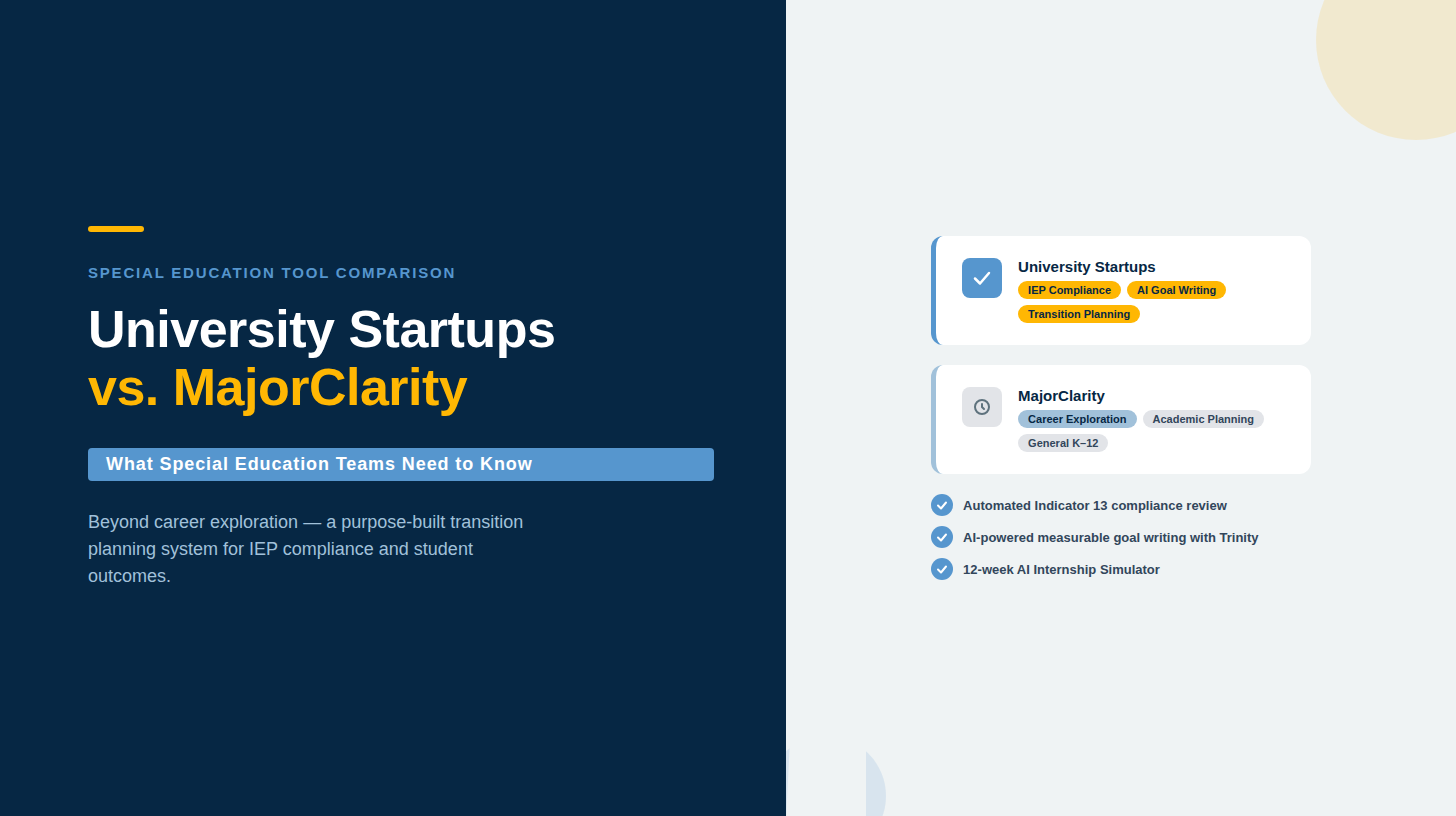
If you're a special education director or transition coordinator evaluating tools for your team, you've probably come across MajorClarity for its CCR curriculum. But if your primary responsibility is transition planning compliance and student outcomes for students with IEPs, you may find that MajorClarity only takes you part of the way there. Here's an honest look at what each tool does, where they differ, and why many districts are now using both.
The Short Answer
MajorClarity is a college and career readiness platform designed for all students. It helps with career exploration, academic planning, and postsecondary decision-making.
University Startups is a Transition Planning Management System built exclusively for special education teams and students with IEPs. It handles the compliance-heavy, educator-intensive work that MajorClarity doesn't touch: AI-powered plan creation, measurable goal writing, and automated IEP transition plan review.
They serve different purposes — which means for many districts, they're not competitors at all. They're complements.
Side-by-Side Comparison
What MajorClarity Does
MajorClarity excels at broad-based career and college readiness programming. Students can explore careers through interactive "test-drives," build multi-year academic plans tied to graduation requirements, research colleges and scholarship opportunities, and earn competency-based micro-credentials.
For special education students, MajorClarity offers some relevant features: text-to-speech, adjustable text sizing, and personalized learning paths that can be adapted to meet IEP or 504 accommodations. The platform also supports educators in documenting student interest data, which can serve as evidence of the Age-Appropriate Transition Assessment (AATA) required by Indicator 13.
In short: MajorClarity can help populate the inputs to a transition plan. But it doesn't build the plan, write the goals, or check the plan for compliance.
Where University Startups Goes Further for Special Education
Transition planning under IDEA is not just career exploration. It's a federally mandated, compliance-driven process with high stakes for students and real administrative burden for educators. University Startups was built specifically for this challenge.
1. A Transition Readiness Score That Actually Drives Planning
University Startups begins with a 14-question Transition Readiness Assessment that establishes a baseline across key domains: self-advocacy, career discovery, employment readiness, and more. Students receive a personalized score with actionable areas for growth — data that directly informs their transition plan and IEP goals.
2. Trinity: Student-Centered Plan Creation
One of the most distinctive tools in the University Startups platform is Trinity, an AI-powered plan creator that centers the student's own voice. Students engage in a short (typically under 10 minutes) session where they reflect on their strengths, interests, preferences, and needs.
Trinity uses their responses to generate personalized postsecondary goals, annual goals, and recommendations for local supports and services — covering education and training, employment, independent living, and community participation. This is the kind of individualization that IDEA requires and that paper-based or generic form tools simply cannot deliver at scale.
3. The AI Internship Simulator: Real Skills, Real Confidence
University Startups includes a 12-week, gamified AI Internship Simulator where students take on the role of an intern in a simulated workplace. Guided by Nova, an AI internship advisor, students rotate through departments, complete realistic work tasks, and practice communication, time management, and project delivery — all in a safe, supportive environment before entering actual work settings.
4. Automated Transition Plan Reviewer
This may be the most time-saving feature for transition coordinators: the Transition Plan Reviewer. Teachers upload a student's IEP, and within two minutes, the system flags non-compliant or incomplete areas within the transition plan and provides specific recommendations for improvement.
The reviewer is trained on federal and state transition planning standards, which means it catches issues that even experienced teachers can miss, and it does it consistently across every single plan in the caseload.
A Note on Compliance: Why It Matters More Than Ever
Under IDEA, Indicator 13 requires that every student with an IEP aged 16 or older (and in many states, younger) have measurable postsecondary goals based on age-appropriate transition assessments, updated annually, with aligned transition services. Noncompliance can trigger corrective action from state education agencies.
Most transition planning software on the market functions as a form-builder — it gives teachers a digital place to type. University Startups is different: it actively supports how goals are written and then reviews the finished plan for compliance, closing the loop in a way that no other platform does.
The Bottom Line: Do You Need Both?
If your district already uses MajorClarity, you don't need to replace it. The career exploration data and student interest profiles MajorClarity generates can feed directly into the University Startups planning process — giving Trinity richer context and giving your IEP team stronger AATA documentation.
Think of it this way:
- MajorClarity helps students explore who they want to become.
- University Startups helps your team build and verify legally compliant, student-centered plans to get them there.
For special education teams navigating growing caseloads, compliance pressure, and a genuine desire to do right by their students, University Startups fills a gap that no other tool in the market , including MajorClarity, currently addresses.
Want to see University Startups in action? Request a demo or watch an introductory video to see how it works for teams like yours.
.png)
.png)


.svg)


